


Are you also one of the organisations facing challenges in managing and coordinating data across diverse SAP systems and non-SAP applications, ensuring data accuracy and consistency?
SAP MDM is the software solution for you that offers a unified view of core business entities as well as data management across diverse departments.
Through this blog, let us uncover what SAP Master Data Management is and how it can be used to distribute and manage master data both within SAP systems and non-SAP applications, with some other interesting areas to discover.
What is SAP MDM?
SAP MDM, or SAP Master Data Management, helps in managing and overseeing essential business data throughout an organisation. It guarantees a single source of truth for all essential entities like customers, products, and suppliers. SAP Master Data Management provides data integration, consolidation, and governance, improving data quality, accuracy, and efficiency. Furthermore, it offers various functionalities including centralised creation, alteration, and distribution of master data, improved efficiency for handling multiple records, enhanced material search capabilities, which result in heightened precision and faster processes.
SAP MDM architecture core principles:

- Centralized data management
- Data integration
- Data governance
- Data syndication
Implementation of SAP MDM architecture:
Coexistence architecture: This approach plays a vital role in allowing master data to exist in multiple systems (both MDM and source systems). Through coexistence architecture, data may be replicated or synchronised between systems.
Registry architecture: It holds the references to master data in the source system, rather than replicating the data itself. Registry offers a unified view of the data through unique identifiers, facilitating data discovery and access.
Transactional architecture (Repository MDM): SAP MDM efficiently handles both reading and modifying master data, making it the primary source of truth.
Consolidation architecture: A Central MDM hub gathers and consolidates master data from diverse source systems. It cleans, matches, and merges data to create a unified “golden record”.
Difference between SAP MDM and SAP MDG
SAP MDM (Master Data Management) and SAP MDG (Master Data Governance) are both SAP solutions for efficiently managing master data, however, they differ in their focus and scope.
| Basis | SAP MDM | SAP MDG |
| Focus | It manages master data across diverse systems, including SAP and non-SAP, with a major focus on data integration and distribution. | SAP MDG ensures data quality, consistency, and governance within the SAP ERP system. |
| Scope | The scope of SAP MDM is broad, covering multiple master data domains and systems. | The primary focus of SAP MDG is on master data within the SAP ERP landscape. |
| Implementation | It is a standalone product, not tied to a specific SAP application like ERP. | It is an add-on for SAP ERP, meaning it mandatorily requires an SAP ERP system. |
| Data Flow | IT often acts as a central hub for data distribution as well as consolidation. | SAP MDG involves data flowing into the ERP system, where it is effectively governed and managed. |
| Integration | MDM has strong integration capabilities with various systems. | It has a limited focus on broad integration with non-SAP systems, more tailored for the SAP ERP scenario. |
To sum up, SAP Master Data Management is more suitable for businesses needing to manage master data across a variety of systems, while SAP Master Data Governance is a better choice for those primarily focused on data quality and governance within the SAP ERP environment.
How to use SAP MDM within SAP systems and non-SAP applications
SAP MDM can be efficiently utilised within the SAP system and with non-SAP applications. It leverages diverse integration methods such as SAP NetWeaver, SAP PI/PO, and SAP Integration Suite. SAP Master Data Management acts as a central hub for managing master data, ensuring consistency and quality across diverse systems.
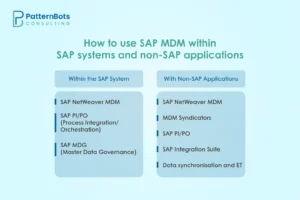
Within the SAP System:
- SAP NetWeaver MDM: The businesses can utilise this solution to aggregate master data from diverse sources, including SAP systems, into a central repository.
- SAP PI/PO (Process Integration/Orchestration): These tools offer various benefits to businesses with data exchanges and integration among different SAP systems, including those that utilise MDM.
- SAP MDG (Master Data Governance): This solution offers a framework for managing master data with SAP S/4HANA or SAP ERP, ensuring consistency and quality of data.
With Non-SAP Applications:
- SAP NetWeaver MDM: It assists businesses in aggregating data from non-SAP systems and acts as a central repository for master data.
- MDM Syndicators: This tool is utilised to distribute harmonised master data to non-SAP applications, providing a significant way to share data among different formats.
- SAP PI/PO: It can be utilised by businesses to establish connections and data flows among non-SAP systems and SAP systems.
- SAP Integration Suite: This platform offers a pre-built connector and harmonised RESTful APIs for precise integration with various non-SAP applications, simplifying the procedure of synchronisation and data exchange.
- Data synchronisation and ETL: Your organisation can utilise different data synchronisation and ETL processes to efficiently transfer data.
If you are looking for the best SAP consultant company for your business, PatternBots can be your go-to solution provider. At PatternBots, our experienced team not only offers SAP consulting services, but we also help you organise your data efficiently to make your workflow smooth. By connecting with PatternBots consulting services, you can become the best SAP central master data organiser.


Leave Comment
Can you be more specific about the content of your article? After reading it, I still have some doubts. Hope you can help me. https://www.binance.com/register?ref=IXBIAFVY
Can you be more specific about the content of your article? After reading it, I still have some doubts. Hope you can help me. https://accounts.binance.com/pt-BR/register-person?ref=GJY4VW8W