


SAP FICO stands for Financial Accounting (FI) and Controlling (CO). It is the most significant module in the SAP ERP (Enterprise Resource Planning) system. It forms the core of financial and managerial accounting within a company, enabling it to manage the financial data effectively and efficiently.
This blog will discuss the features of SAP FICO, its role in the SAP S/4HANA Cloud environment, how it interacts with other SAP modules, and how integration platforms like PatternBots enhance its functionality.
SAP FICO: What Is It?
SAP FICO includes the following two prime components.
Financial Accounting (FI)
This module resembles the management of all financial transactions within the business. It guarantees correct accounting, compliance, and generation of critical financial statements like balance sheets and profit-and-loss accounts.
Controlling (CO)
This module assists businesses in reporting and managing internal costs and performance. It informs on resource consumption, thereby enabling relevant reports to facilitate decision-making and strategic planning.
SAP FICO is regarded as one of the core SAP ERP modules due to its interaction with other modules for financial management in industries.
Key Capabilities of SAP FICO
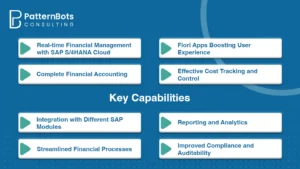
Real-time Financial Management with SAP S/4HANA Cloud
SAP S/4HANA Cloud is next generation ERP software that runs on the SAP HANA in-memory platform. For businesses, this allows for real-time processing and analytics with speed and precision within their financial data management.
SAP FICO integrates with the SAP S/4HANA cloud seamlessly and conducts financial processes in real-time, thereby reducing the scope of manual interventions and making accounting operations less error-prone. Cloud-based systems give one extended flexibility, scalability, and fast deployment, which is important for international operations. PatternBots further enhance SAP FICO by enabling seamless integration with external financial systems, ensuring a unified data flow between SAP and non-SAP applications.
Fiori Apps Boosting User Experience
User experience is one of several distinct advantages conferred by SAP Fiori apps. These apps provide a contemporary, intuitive, and personalised experience for users across devices: users can easily access the complex functionalities of SAP FICO using SAP Fiori for localised access to the most critical financial data and analytics.
The apps provide such functionalities as an invoice manager, payment processing, and cost centre tracking for enhanced financial teams’ working productivity and efficiency.
Complete Financial Accounting
The FI module in SAP FICO performs financial accounting functions, such as recording transactions and preparing balance sheets, accounts payable and receivable. Key functions in this module include:
- General Ledger (G/L): Centralising all financial data for reporting purposes.
- Accounts Payable (AP): Receiver of suppliers’ invoices and payments.
- Accounts Receivable (AR): Receiver of clients’ invoices and payments.
- Asset Accounting (AA): Managing corporate assets and depreciation.
Effective Cost Tracking and Control
The CO module provides systematic recording and controlling of the internal costs of a company. This allows for better control over costs and assessment of performance. Key CO functions include:
- Cost centres: To track all organisational expenses, up to the centre, such as departments or activities.
- Internal orders: Operating expenses associated with specific projects/events.
- Profit centres: To examine performance based on different lines of business.
- Variance analysis: Comparing estimated versus actual expenses in order to recognise areas needing improvement.
Integration with Different SAP Modules
Previously, SAP FICO has remained one of the most significant modules that integrate seamlessly with the other SAP modules, such as, but not limited to, SAP MM (Material Management), SAP SD (Sales and Distribution), and SAP PP (Production Planning).
This means one’s financial information will be automatically updated from one system to the other in real time. This cuts down on manual data postings and assures uniformity across units/departments.
Reporting and Analytics
Reporting and analysis have been made easy for the users of SAP FICO by offering detailed financial reports that provide insight into the financial health of the organisation. Creation of reports has been real-time analytics that allows managers to track performance, budget control, and decisions aimed at enhancing the organisation’s profitability.
The capabilities of SAP S/4HANA Cloud allow businesses to take a further step ahead in change management by developing intuitive reports like real-time dashboards and predictive analytics to make sense of trends in financial data.
Streamlined Financial Processes
SAP FICO helps streamline several financial processes such as closing the books at the month, quarter, or year-end. It automates many processes involving posting journal entries, reconciling accounts, and depreciation calculation.
SAP S/4HANA Cloud elevates the delivery of this service by performing it quicker and with more accurate calculations while lessening the time spent on manual calculations, which optimises financial management at large.
Improved Compliance and Auditability
Compliance with financial regulations is essential for every business. SAP FICO enables organisations to comply with legal and regulatory standards through accurate financial reporting, strong documentation, and auditability.
The connection with SAP S/4HANA Cloud offers businesses enhanced control over their financial data, ensuring transparency and making audits more manageable.
Why SAP FICO is Important for Companies
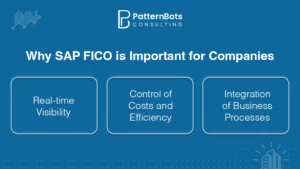
In the modern enterprise, has greater complexity calls for systematic finance administration. The ERP-based business offers substantial financial insight to organisations through its usage, such as:
- Real-time Visibility
It provides a comprehensive view of financial data with a user-friendly reporting and analytics system for real-time reporting so that they can make some of the best-informed decisions. - Control of Costs and Efficiency
The Controlling Department module assists enterprises by effective cost management to focus on expenses that could eventually stimulate costs. - Integration of Business Processes
It facilitates linking financial data with procurement, sales, and production processes so that current financial data gets reflected correctly in all departments.
How SAP FICO Relates to Other SAP Modules
SAP FICO connects with other SAP modules, which helps an enterprise operate seamlessly across the different functions of its business. For example:
- SAP MM (Material Management): Deals with inventory, purchasing, and vendor data. It is integrated into SAP FICO; this closes financial transactions for material procurement at the system end.
- SAP SD (Sales and Distribution): Tracks the sales processes, customer orders, and invoicing. Integration with SAP FICO ensures that payments from customers and receivables are properly acknowledged in the books.
- SAP PP (Production Planning): This revolves around managing the production process. The integration with SAP FICO tracks costs related to production and resource usage.
Conclusion
PatternBots provides a powerful integration framework that enhances financial management by seamlessly connecting SAP FICO with other enterprise applications. While SAP FICO ensures accurate financial reporting, cost control, and compliance within the SAP ecosystem, PatternBots extends these capabilities by enabling smooth data exchange between SAP and non-SAP systems.
PatterBots ensures businesses can maintain a unified financial view, automate workflows, and optimise decision-making across multiple platforms. As organisations scale, PatternBots complements SAP FICO by providing the flexibility and agility needed to adapt to evolving financial and operational demands, making it a valuable asset for modern enterprises.


Leave Comment
Thanks for sharing. I read many of your blog posts, cool, your blog is very good. https://www.binance.com/ar/register?ref=FIHEGIZ8
Can you be more specific about the content of your article? After reading it, I still have some doubts. Hope you can help me.